Free prompts · Free PDF
30 days of journaling prompts
One prompt a day for a month — each one doing a specific job the research says writing can do.
Journaling works, and it works for reasons that are now fairly well understood: putting an experience into words lowers emotional reactivity, naming a feeling precisely changes how the brain handles it, and writing about yourself from a distance makes hard things easier to look at. Most prompt lists ignore all of that and hand you thirty random questions.
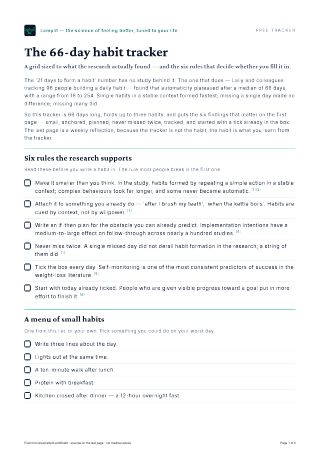
These thirty are sequenced. Week one just gets you writing. Week two trains you to name feelings precisely. Week three uses self-distancing and gratitude. Week four turns what you learned into plans for the next 66 days — the median time a habit took to form in the one real-world study of it.
Five rules for writing that helps
Read these once. The prompts do the rest.
Write for yourself, not an audience. Spelling, grammar and handwriting don't matter — the benefit comes from putting the experience into words at all.[2]
Name feelings precisely. Labelling an emotion in words lowers activity in the amygdala; 'tense' and 'disappointed' do more than 'bad'.[3]
End each entry with a mood check: overall mood → the specific feeling underneath → the area of life it touched. Fine-grained emotional tracking is linked with better emotion regulation.[4]
Re-read every seventh day. Patterns are the point; a single entry rarely tells you much.
Week 1 — Show up
The only goal this week is to write. Quality is not the point yet; the neural pathway is: at this time, in this place, I write.
- 1
What is one thing that went better than expected today, and what made it go that way?
- 2
Describe today in three sentences: what happened, how it felt, what you would keep.
- 3
What did your body need today that it did not get — sleep, food, movement, rest?
- 4
Write down one worry, then the smallest next action you could take on it.
- 5
What gave you energy today? What drained it?
- 6
Name the strongest feeling you had today as precisely as you can. Not 'bad' — irritated, restless, disappointed, tense?
- 7
Re-read this week's entries. Which word or theme shows up more than once?
Week 2 — Name it
This week trains emotional granularity. Each time you replace a vague feeling with a precise one, you are doing the thing the research calls affect labelling.
- 8
Pick a moment today when your mood shifted. What was the trigger, and what exactly changed?
- 9
Describe a feeling you had today in three steps: the overall mood, the specific feeling underneath, and the area of life it touched.
- 10
What are you avoiding thinking about? Write about it for five minutes without stopping.
- 11
When did you last feel calm? Describe the setting in sensory detail — light, sound, temperature.
- 12
What did someone say or do today that stuck with you? Why did it land?
- 13
Write about a small frustration as if explaining it to a friend who was not there.
- 14
Look back at this week. Which feelings were easy to name, and which took work?
Week 3 — Step back
Self-distancing — writing about yourself as you would about someone else — makes difficult experiences easier to process without dampening them. Gratitude writing, done specifically, raises well-being in controlled studies.[5][6]
- 15
Describe a difficult moment from this week in the third person, using your own name.
- 16
What would you tell a close friend who was in your exact situation right now?
- 17
List three things you are grateful for — then write one sentence on why each one happened.
- 18
What is a belief about yourself that today gave you evidence against?
- 19
Which of your habits is quietly serving your future self? Which one is quietly costing it?
- 20
Write about something you handled better this year than you would have a year ago.
- 21
What is one thing you can control tomorrow, and one thing you cannot?
- 22
Re-read week three. Did writing from a distance change how any of it felt?
Week 4 — Build forward
The last week turns reflection into plans. Implementation intentions — 'after X, I will Y' and 'if X happens, then I will Y' — have a medium-to-large effect on follow-through across nearly a hundred studies.[7][8]
- 23
Choose one habit for the next 66 days. Write it as: 'After I [existing routine], I will [tiny action].'
- 24
What will get in the way of that habit? Write an if-then plan for each obstacle you can already see.
- 25
Describe your ideal ordinary Tuesday five years from now — not a holiday, a normal day.
- 26
What do you want your sleep, your movement and your food to look like next month? One sentence each.
- 27
Who helps you stay on track, and how could you make that easier for them?
- 28
What did tracking your mood teach you this month that you did not know on day one?
- 29
Write a letter to yourself to open in 66 days. What do you hope is different?
- 30
Which prompt from this month would you keep asking yourself? Why that one?
How to use it
- 1
Pick a time and a place and keep them. The habit forms around the context, not the content.
- 2
One prompt a day, in order. If a prompt does not fit the day, write about why — that is an entry too.
- 3
Close every entry with the three-step mood check. It takes twenty seconds and it is what turns a diary into data.
- 4
Re-read on days 7, 14, 22 and 30. The re-reading prompts are where most people notice the first pattern.
- 5
In Lamplit, the free journal gives you three guided prompts and the same three-step mood tracker every day, keeps your streak, and charts your mood over weeks — so the pattern finds you.
Common questions
Do I have to write every day?
No — but consecutive days are how the original studies were run, and a fixed daily slot is how the habit forms. If you miss a day, do not double up; just continue with the next prompt. Missing one day did not derail habit formation in the research; a string of them did.
Handwritten or typed?
Either. The mechanism is putting experience into words, and the studies have used both. Handwriting slows you down, which some people find helps; typing makes re-reading and searching easier, which is what the app is for.
What if a prompt brings up something upsetting?
Expressive writing about difficult experiences can feel worse for a few hours and better over weeks — that pattern is well documented. Write for the time you set and then stop. If what comes up feels unmanageable, or if you are dealing with trauma, work with a therapist rather than a worksheet.
Sources
Where an item rests on a specific source, the number in brackets points to it. Every source is linked.
- 1.Pennebaker, J.W. & Beall, S.K. (1986). Confronting a traumatic event: toward an understanding of inhibition and disease. Journal of Abnormal Psychology, 95(3), 274–281. Read the paper ↗
- 2.Pennebaker, J.W. (1997). Writing about emotional experiences as a therapeutic process. Psychological Science, 8(3), 162–166. Read the paper ↗
- 3.Lieberman, M.D. et al. (2007). Putting feelings into words: affect labeling disrupts amygdala activity in response to affective stimuli. Psychological Science, 18(5), 421–428. Read the paper ↗
- 4.Barrett, L.F., Gross, J., Christensen, T.C. & Benvenuto, M. (2001). Knowing what you're feeling and knowing what to do about it: mapping the relation between emotion differentiation and emotion regulation. Cognition & Emotion, 15(6), 713–724. Read the paper ↗
- 5.Kross, E. & Ayduk, O. (2017). Self-distancing: theory, research, and current directions. Advances in Experimental Social Psychology, 55, 81–136. Read the paper ↗
- 6.Emmons, R.A. & McCullough, M.E. (2003). Counting blessings versus burdens: an experimental investigation of gratitude and subjective well-being in daily life. Journal of Personality and Social Psychology, 84(2), 377–389. Read the paper ↗
- 7.Gollwitzer, P.M. & Sheeran, P. (2006). Implementation intentions and goal achievement: a meta-analysis of effects and processes. Advances in Experimental Social Psychology, 38, 69–119. Read the paper ↗
- 8.Lally, P., van Jaarsveld, C.H.M., Potts, H.W.W. & Wardle, J. (2010). How are habits formed: modelling habit formation in the real world. European Journal of Social Psychology, 40(6), 998–1009. Read the paper ↗
Last reviewed: August 24, 2026
These prompts support reflection and are not a substitute for mental health care. If you are experiencing persistent low mood, anxiety or thoughts of harming yourself, please contact a clinician or a local crisis line.